

ESG stands for environmental, social and governance. When people ask what ESG stands for, they are really asking how a company behaves towards the planet and people, and how it is managed. In simple terms, ESG stands for environmental, social, and governance practices that demonstrate an organisation’s responsibility and sustainability.
This ESG guide explains what ESG means, what the ESG criteria are, why they matter for business and investing, and how you can start bringing ESG into your workplace step by step.
What is ESG?
ESG is a framework for assessing how a company performs beyond profit. It focuses on three questions:
- How does the business affect the environment?
- How does it treat people and communities?
- How is it led, managed and controlled?
Investors, regulators, employees and customers now use ESG criteria to assess sustainability and long‑term resilience. Instead of looking only at financial results, they also ask:
- Is this company ready for climate risks?
- Does it respect human rights and fair labour practices?
- Is its leadership transparent and accountable?
Because of this, ESG is no longer “nice to have”. It is part of the core business strategy, risk management and brand reputation.
The Three Dimensions of ESG
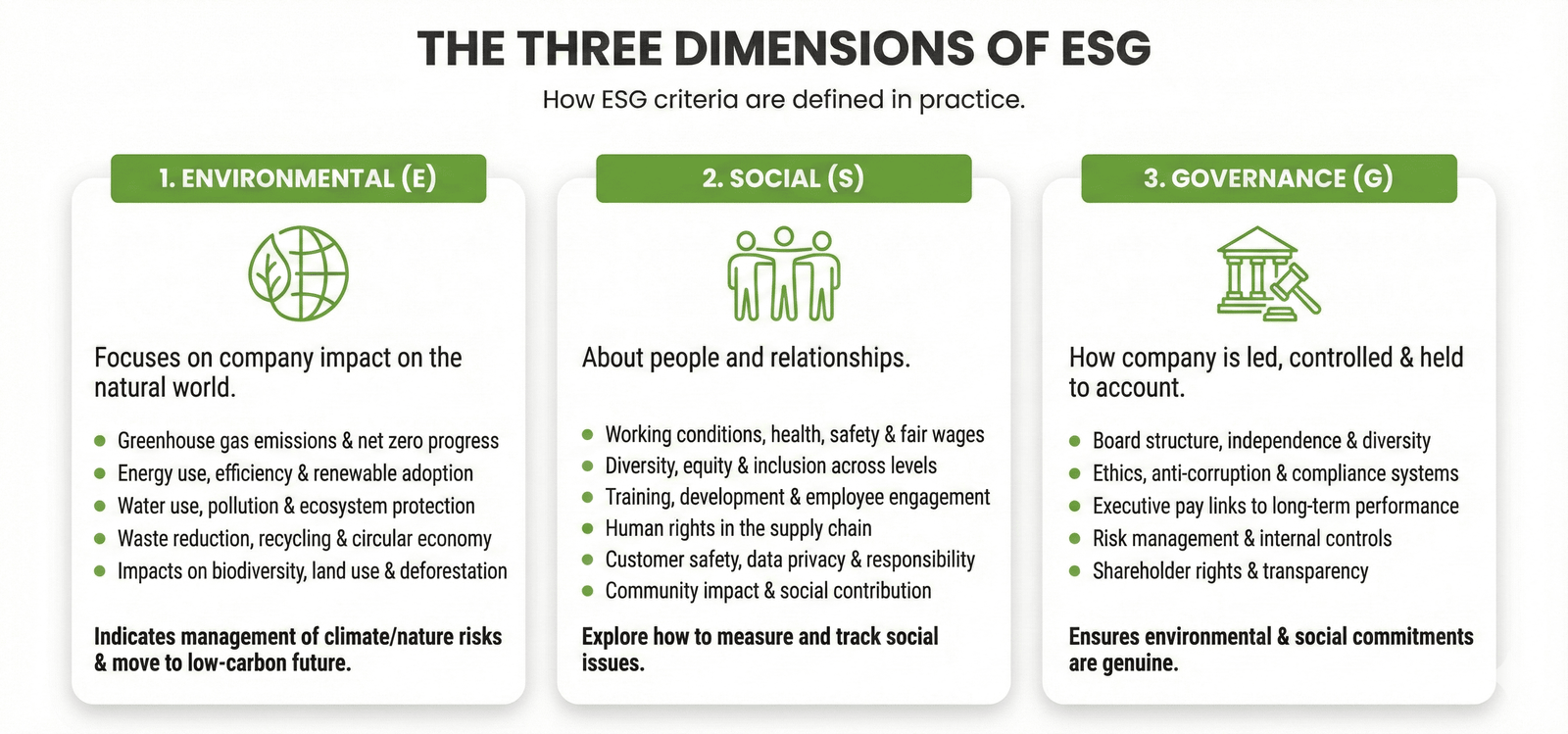
The three dimensions of ESG help define what the ESG criteria are in practice.
1. Environmental (E)
The environmental dimension focuses on how a company impacts the natural world. Typical ESG criteria to assess sustainability include:
- Greenhouse gas emissions and progress towards net zero
- Energy use, efficiency and renewable energy adoption
- Water use, pollution and protection of local ecosystems
- Waste reduction, recycling and circular economy practices
- Impacts on biodiversity, land use and deforestation
These environmental factors indicate whether a company is managing climate and nature‑related risks and whether it is moving towards a low‑carbon, resource‑efficient future.
2. Social (S)
The social dimension is about people and relationships. It looks at:
- Working conditions, health and safety, and fair wages
- Diversity, equity and inclusion across all levels
- Training, development and employee engagement
- Human rights in the supply chain
- Customer safety, data privacy and product responsibility
- Community impact and social contribution
If you want to go deeper into this “S” pillar, you can explore how to measure and track social issues in ESG.
3. Governance (G)
Governance covers how the company is led, controlled and held to account. Standard governance criteria include:
- Board structure, independence and diversity
- Ethics, anti‑corruption and compliance systems
- Executive pay and how it links to long‑term performance
- Risk management and internal controls
- Shareholder rights and transparency of decision‑making
Strong governance increases the likelihood that environmental and social commitments are genuine, not just marketing.
Why is ESG Important?
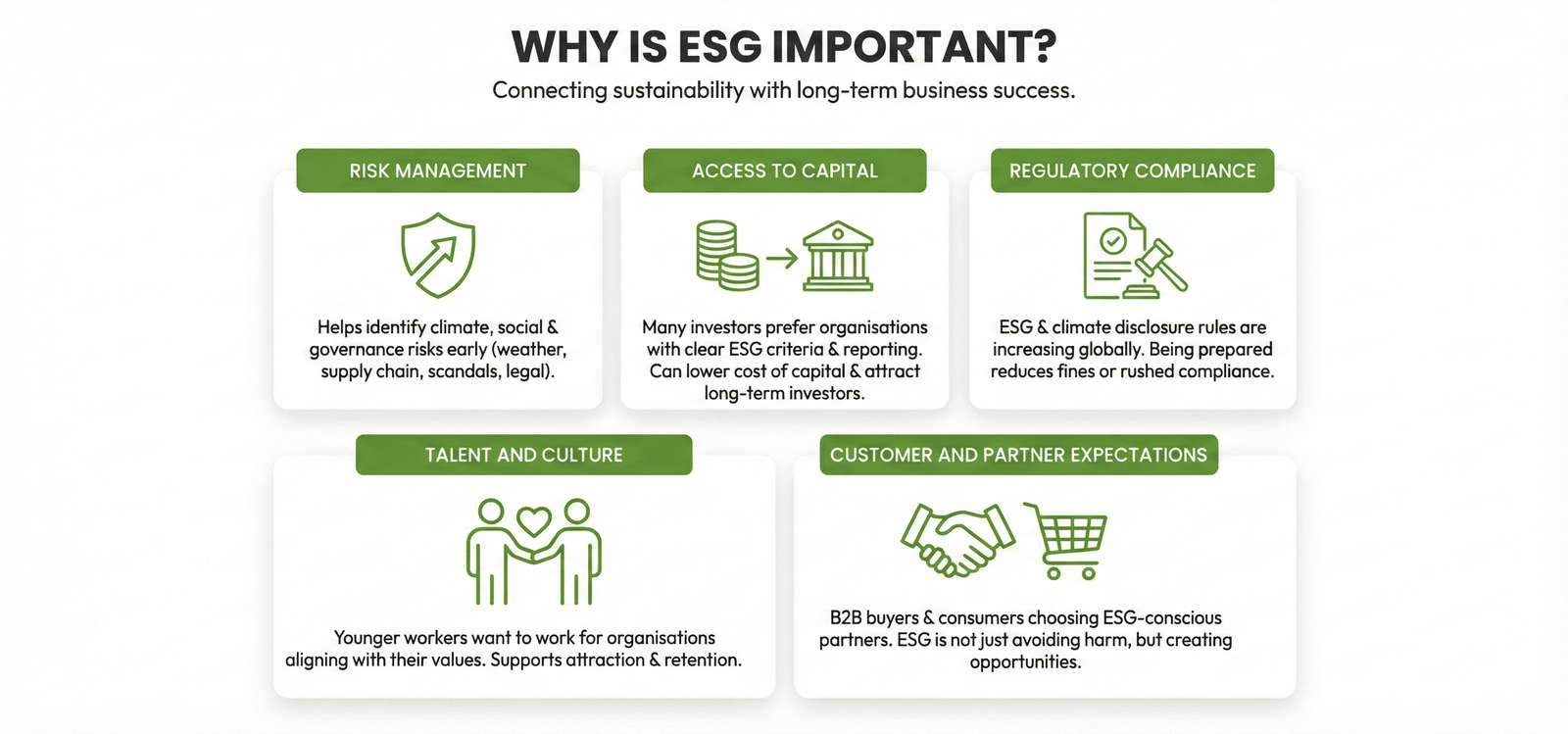
ESG is crucial because it links sustainability with long‑term business success:
- Risk management: ESG helps identify climate, social and governance risks early, from extreme weather and supply chain disruption to scandals or legal cases.
- Access to capital: Many investors now prefer organisations with clear ESG criteria and credible ESG reporting. This can lower the cost of capital and attract long‑term investors.
- Regulatory compliance: ESG regulations and climate disclosure rules are increasing worldwide. Being prepared reduces the risk of fines or rushed compliance.
- Talent and culture: Younger workers in particular want to work for organisations that align with their values. A clear ESG strategy can support attraction and retention.
- Customer and partner expectations: B2B buyers and consumers are choosing ESG‑conscious partners. Learn more about this shift and why businesses are opting for ESG‑conscious partners in B2B.
When executed well, ESG is not only about avoiding harm. It also creates opportunities for new products, markets and business models.
ESG Investing vs Other Investment Strategies
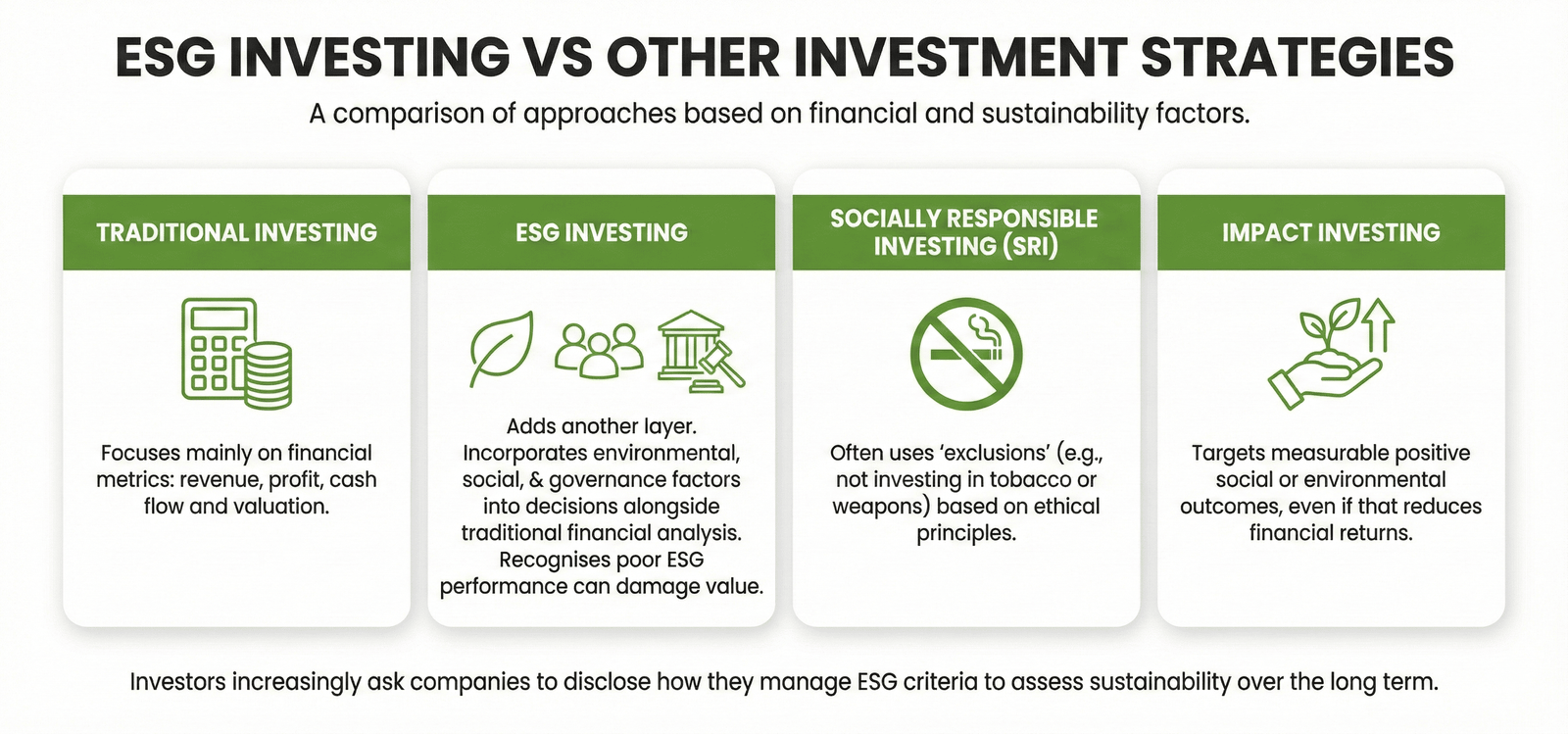
ESG investing is an approach in which investors incorporate environmental, social, and governance factors into their decisions, alongside traditional financial analysis.
In simple terms:
- Traditional investing focuses mainly on financial metrics such as revenue, profit, cash flow and valuation.
- ESG investing adds another layer, asking how ESG risks and opportunities may affect long‑term performance.
- Socially responsible investing (SRI) often uses “exclusions” (e.g., not investing in tobacco or weapons) based on ethical principles.
- Impact investing goes further, targeting measurable positive social or environmental outcomes, even if that reduces financial returns.
ESG investing does not mean ignoring financial performance. Instead, it recognises that poor ESG performance can damage value through fines, boycotts, supply chain issues or stranded assets. To see how companies can benefit from this shift, explore ESG investing and the sustainable investment trend.
Because of this, investors increasingly ask companies to disclose how they manage ESG criteria to assess sustainability over the long term.
How Are ESG Metrics Disclosed?
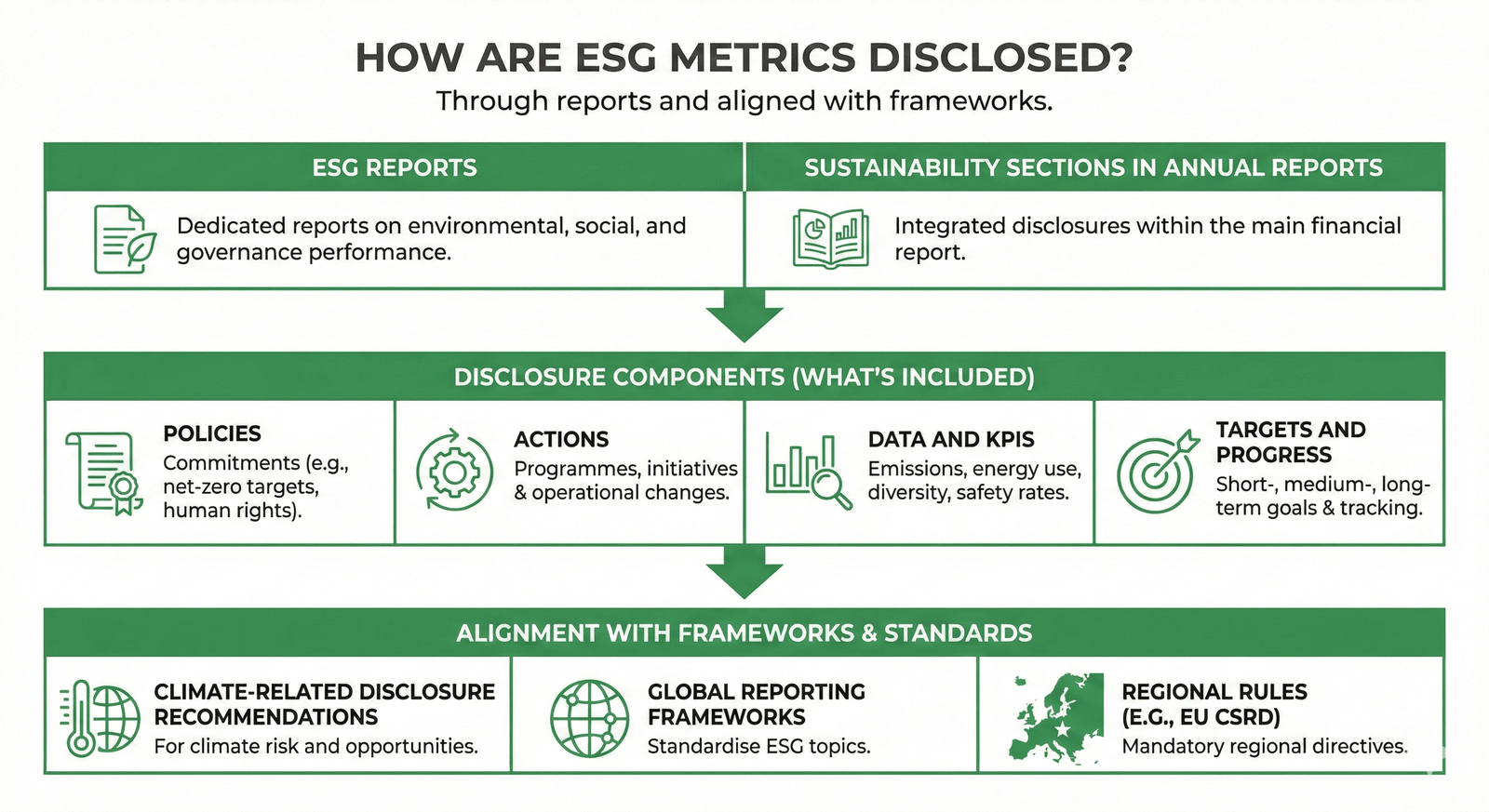
Companies disclose ESG metrics mainly through ESG reports and sustainability sections in annual reports. These disclosures usually include:
- Policies: what the company has committed to (for example, net‑zero targets, human rights policies).
- Actions: programmes, initiatives and changes in operations.
- Data and KPIs: emissions, energy use, diversity numbers, safety rates and other indicators.
- Targets and progress: short‑, medium‑ and long‑term goals and how the company is tracking against them.
Many organisations align their ESG reporting with recognised frameworks and standards, such as:
- Climate‑related disclosure recommendations (for climate risk and opportunities)
- Global reporting frameworks that standardise ESG topics
- Regional rules such as the EU Corporate Sustainability Reporting Directive (CSRD)
To make this process easier and more robust, many organisations turn to ESG reporting solutions and digital tools.
If you are struggling with the process, these practical tips can help make it less painful: How to make the ESG reporting process less painful.
Digital technology is also becoming essential for collecting data and meeting carbon regulations. Read more about this in leveraging digital technology for ESG reporting to meet carbon regulations and sustainability goals.
What Are ESG Regulations?
ESG regulations set minimum expectations for how companies report and, in some cases, how they act. They can include:
- Mandatory climate and ESG disclosure laws that require companies to report on emissions, climate risks and sustainability impacts
- Sustainable finance rules that ask financial institutions to explain how they consider ESG in their investment decisions.
- Due diligence laws on human rights and environmental impacts in supply chains
- Sector‑specific rules for high‑impact industries such as energy, mining or agriculture
These regulations push companies to improve data quality and transparency. They also make ESG criteria to assess sustainability more consistently across markets.
ESG Reporting in Practice
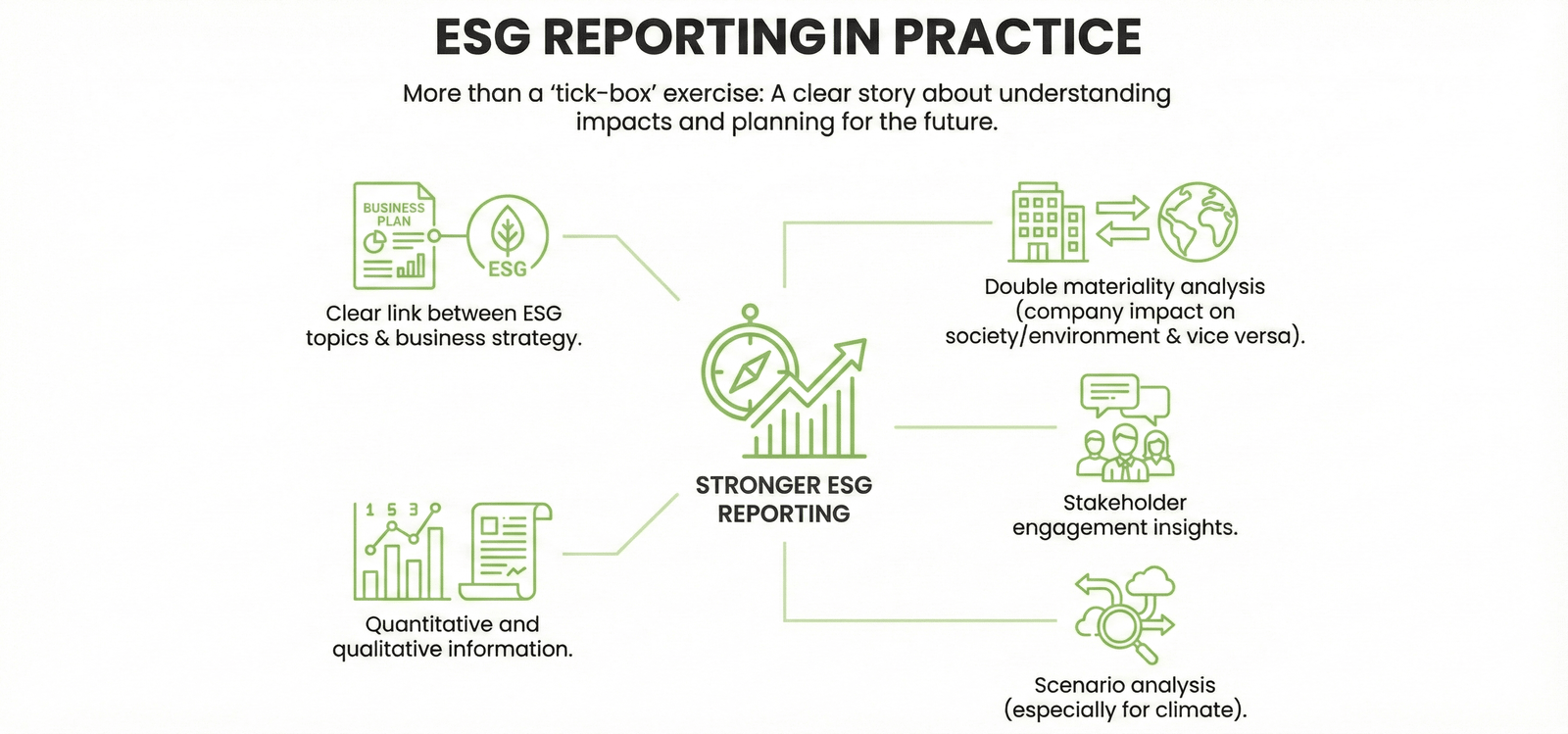
ESG reporting is not just a “tick‑box” exercise. Done well, it creates a clear story about how your organisation understands its impacts and plans for the future.
Stronger ESG reporting often includes:
- A clear link between ESG topics and the business strategy
- Double materiality analysis (how ESG issues affect the company and how the company affects society and the environment)
- Stakeholder engagement insights
- Scenario analysis, especially for climate
- Quantitative and qualitative information
ESG communication is also key. You need messages that are accurate, engaging and adapted to your audiences. For support with this, see effective and engaging ESG communications strategies.
For companies operating across multiple languages and regions, the importance of translating ESG to amplify their impact across borders is growing. Natural‑language technologies can help scale this work; learn more about natural language processing and ESG sustainability communication.
Environmental Factors: Key ESG Criteria
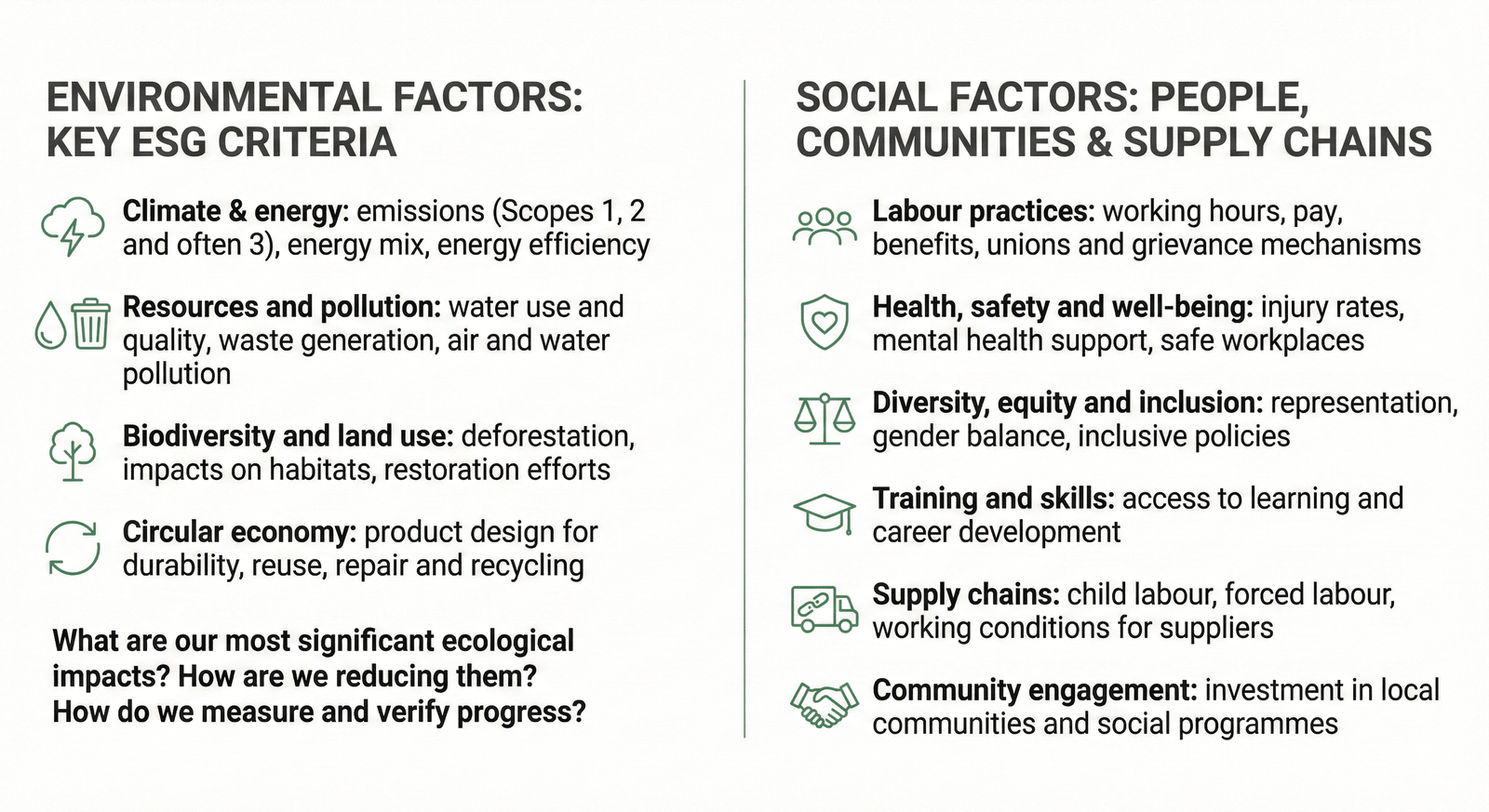
Environmental factors in ESG typically cover:
- Climate and energy: emissions (Scopes 1, 2 and often 3), energy mix, energy efficiency
- Resources and pollution: water use and quality, waste generation, air and water pollution
- Biodiversity and land use: deforestation, impacts on habitats, restoration efforts
- Circular economy: product design for durability, reuse, repair and recycling
When you ask “what are the ESG criteria?” for the environmental pillar, think about:
- What are our most significant ecological impacts?
- How are we reducing them?
- How do we measure and verify progress?
Social Factors: People, Communities and Supply Chains
Social factors focus on how your organisation affects people. Critical ESG criteria here include:
- Labour practices: working hours, pay, benefits, unions and grievance mechanisms
- Health, safety and well-being: injury rates, mental health support, safe workplaces
- Diversity, equity and inclusion: representation, gender balance, inclusive policies
- Training and skills: access to learning and career development
- Supply chains: child labour, forced labour, working conditions for suppliers
- Community engagement: investment in local communities and social programmes
Measuring social performance can be more complex than counting emissions, but it is just as crucial for long‑term resilience and reputation.
Practical Steps for ESG Implementation in the Workplace
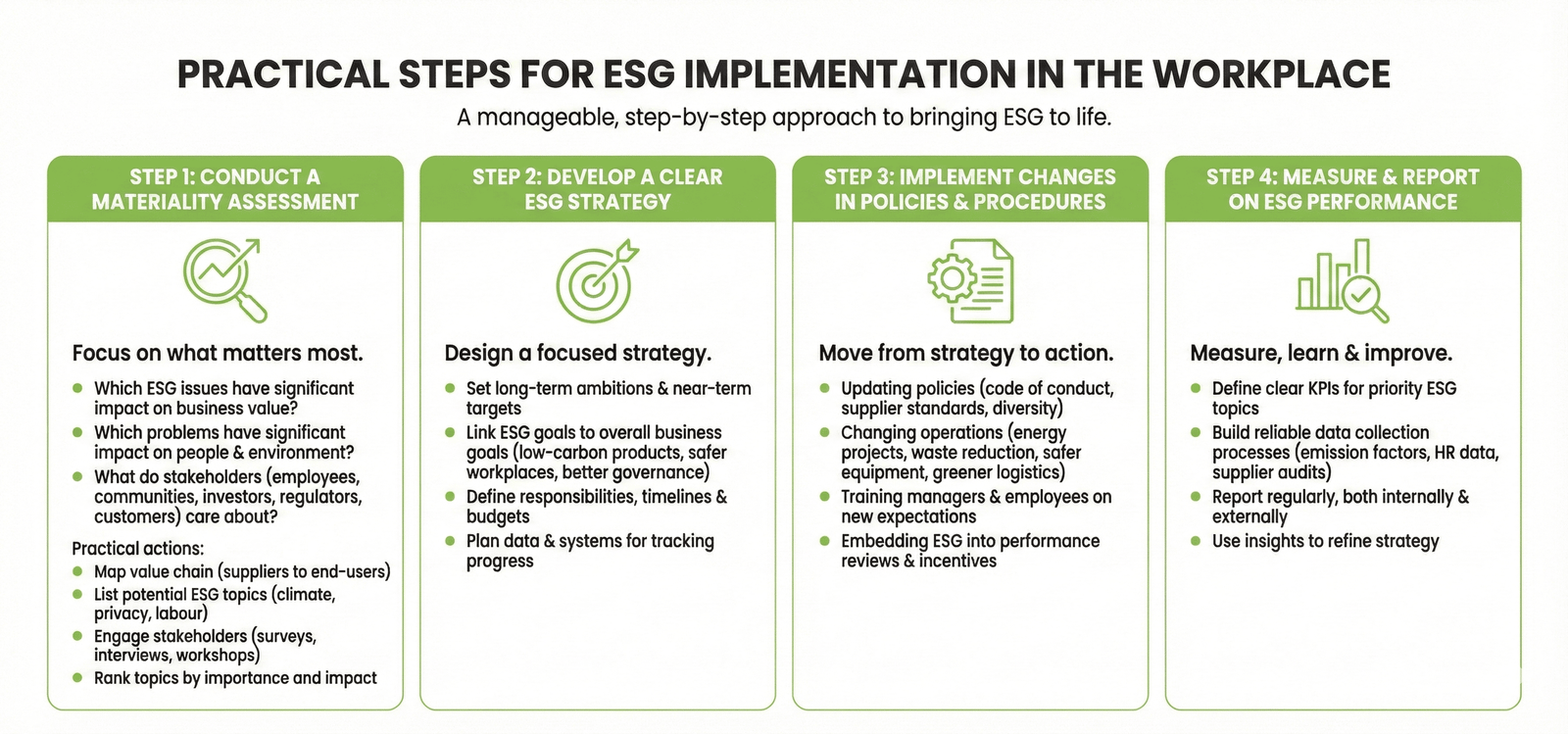
Bringing ESG to life in your organisation can feel overwhelming. A step‑by‑step approach can make it manageable. For a broader roadmap, you can refer to the ten vital steps in the ESG implementation process.
Step 1: Conduct a Materiality Assessment
A materiality assessment helps you focus on what matters most. It asks:
- Which ESG issues have the most significant impact on our business value?
- Which problems have the most significant impact on people and the environment?
- What do our stakeholders (employees, communities, investors, regulators, customers) care about most?
Practical actions:
- Map your value chain from suppliers to end‑users
- List potential ESG topics (for example, climate risk, data privacy, labour rights)
- Engage stakeholders through surveys, interviews or workshops
- Rank topics by importance and impact
This gives you a clear, evidence‑based list of priorities.
Step 2: Develop a Clear ESG Strategy
Once you know what matters, you can design a focused ESG strategy. This should:
- Set long‑term ambitions and near‑term targets
- Link ESG goals to overall business goals (for example, low‑carbon products, safer workplaces, better governance)
- Define responsibilities, timelines and budgets
- Plan the data and systems you need to track progress
To explore how ESG supports growth, see Understanding ESG Strategy to add value for your business growth.
Step 3: Implement Changes in Policies and Procedures
After strategy comes action. This may involve:
- Updating policies (for example, code of conduct, supplier standards, diversity policies)
- Changing operations (energy projects, waste reduction, safer equipment, greener logistics)
- Training managers and employees on new expectations and behaviours
- Embedding ESG into performance reviews and incentives
Digital tools can support this shift. Learn how localised digitalisation can enable sustainable business growth across different markets.
Step 4: Measure and Report on ESG Performance
Finally, you need to measure, learn and improve:
- Define clear KPIs for each priority ESG topic
- Build reliable data collection processes (for example, emission factors, HR data, supplier audits)
- Report regularly, both internally and externally
- Use insights to refine your strategy
Investors and other stakeholders will expect transparent reporting. For a more systems‑level view, see how to make the ESG reporting process less painful and consider how digital technology for ESG reporting can help you meet new expectations.
How ESG Reshapes the Workplace
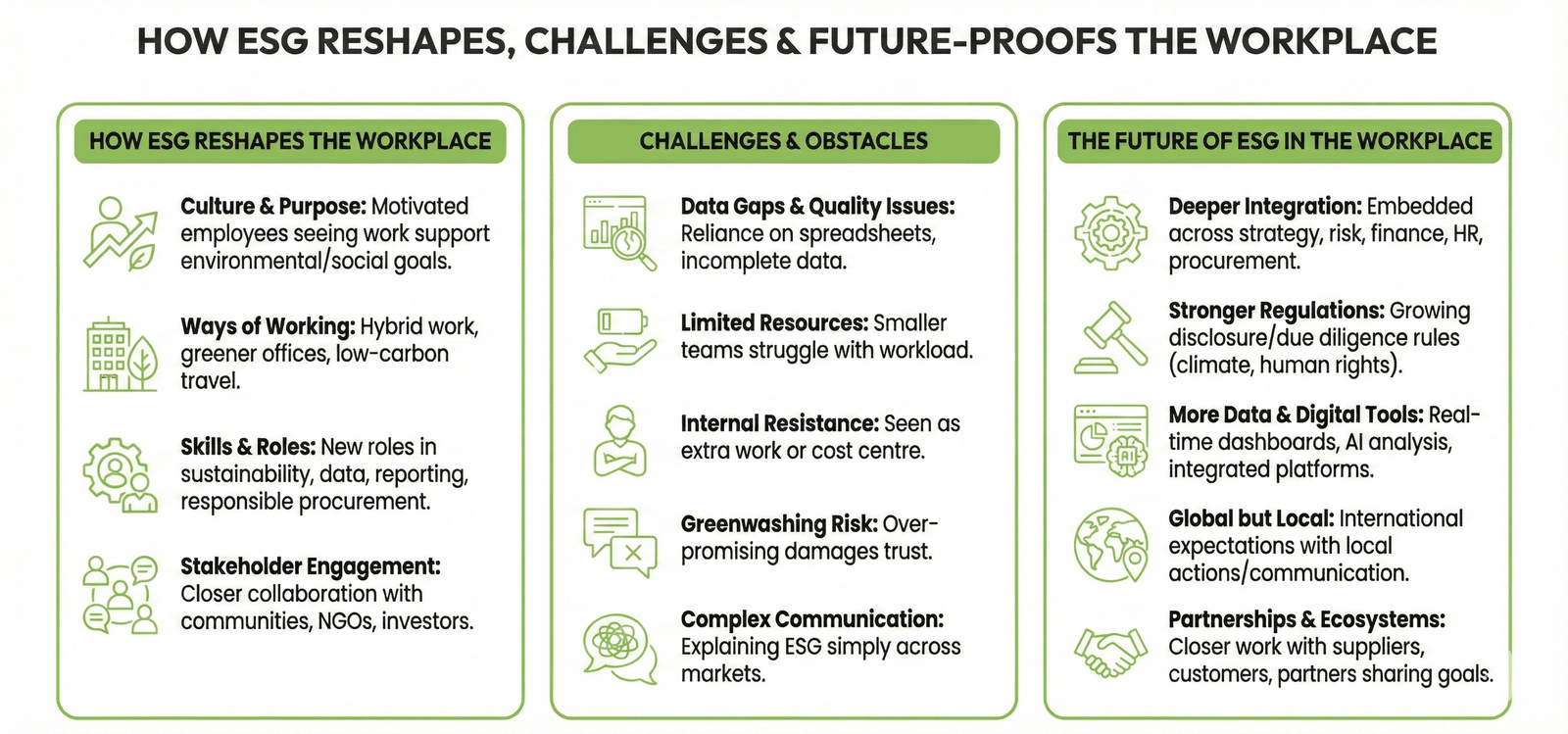
ESG is reshaping the workplace in several ways:
- Culture and purpose: Employees are more motivated when they see how their work supports environmental and social goals.
- Ways of working: Hybrid work, greener offices, and low‑carbon travel policies are becoming part of ESG strategies.
- Skills and roles: New roles are emerging in sustainability, ESG data, reporting, and responsible procurement.
- Stakeholder engagement: Teams work more closely with communities, NGOs and investors.
Engaging stakeholders is critical. For practical ideas, read strategies for engaging with stakeholders and attracting new investors.
Marketing and communication teams also play an increasingly important role. They must present ESG work honestly and meaningfully. Explore this further in the challenges of ESG marketing and in effective, engaging ESG communication strategies.
Challenges and Obstacles in the Workplace
ESG implementation is not easy. Common challenges include:
- Data gaps and quality issues: Many organisations still rely on spreadsheets or incomplete data.
- Limited resources: Smaller teams may struggle with the workload of ESG reporting and initiatives.
- Internal resistance: Some employees or leaders may see ESG as extra work or a cost centre.
- Greenwashing risk: Over‑promising or unclear claims can damage trust if results do not match.
- Complex communication: Explaining ESG in simple, consistent language across markets can be hard.
Technology, language services and transparent internal governance can help. For instance, advanced text analytics can support monitoring of ESG narratives; see natural language processing and ESG sustainability communication for more details.
The Future of ESG in the Workplace
The future of ESG in the workplace is likely to include:
- Deeper integration: ESG will be embedded across strategy, risk, finance, HR, procurement, and marketing, rather than handled by a single team.
- Stronger regulations: Disclosure and due diligence rules will continue to grow, especially in the areas of climate and human rights.
- More data and digital tools: Real‑time dashboards, AI‑supported analysis and integrated platforms will become standard.
- Global but local: ESG expectations will be international, but actions and communication must fit local cultures and languages.
- Partnerships and ecosystems: Companies will work more closely with suppliers, customers and partners who share their ESG goals.
As ESG matures, organisations will move from asking “what does ESG stand for?” to “how can ESG drive better decisions every day?” That is where real impact happens.
Take Your Next Step: Talk to an ESG Expert
If you are ready to move from theory to action, specialised guidance can save time and reduce risk. An experienced partner can help you:
- Identify the most material ESG topics for your business
- Design a strategy with realistic targets and timelines
- Build effective reporting and communication plans
- Choose the right tools and processes for data and disclosure
To explore how this could work for your organisation, arrange an ESG consultation and start turning ESG commitments into measurable results.